 |
uvi-script
Musical event scripting with Lua
|
|
uvi-script
Musical event scripting with Lua
|
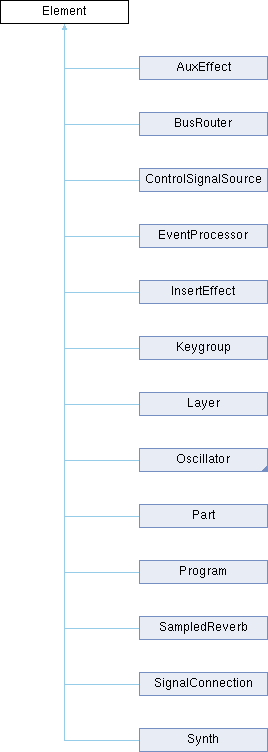
Common Elements base class. More...
Public Member Functions | |
| void | setParameter (string parameter, Value value) |
| Sets an Element parameter. | |
| Value | getParameter (string parameter) |
| Gets an Element parameter. | |
| bool | hasParameter (string parameter) |
| table | getParameterConnections (string parameter) |
| Get all SignalConnection for this parameter. | |
Public Attributes | |
| string | name |
| internal element name | |
| string | displayName |
| name to display on the User Interface, name is used if displayName is not specified. | |
| string | type |
| internal element type | |
| string | path |
| full path of the element in the synthesis tree | |
| Element & | parent |
| element parent | |
| table | children |
| element children using the element name as key | |
| table | synthChildren |
| children of the element in the synthesis hierarchy, as a 1-indexed array. | |
| table | mods |
all ControlSignalSource for this node as a 1-indexed array (same content as modulations, keyed by index instead of name) | |
| int | output |
| output bus index for the element. Reading returns the index parsed from the current output bus name (1 when the element uses the default bus). Writing is asynchronous: the engine applies the new routing shortly after the assignment, so reading the property back immediately may still return the old value. Assigning on an element that cannot change its output raises an error. | |
| int | numParams |
| number of parameters | |
| table | parameterDefinitions |
| table of parameter definitions. | |
Common Elements base class.
| Value Element::getParameter | ( | string | parameter | ) |
Gets an Element parameter.
| parameter | parameterName or parameterId |
| table Element::getParameterConnections | ( | string | parameter | ) |
Get all SignalConnection for this parameter.
| parameter | parameterName or parameterId |
| bool Element::hasParameter | ( | string | parameter | ) |
| void Element::setParameter | ( | string | parameter, |
| Value | value ) |
Sets an Element parameter.
| parameter | parameterName or parameterId |
| value | parameterValue (number|bool|string) according to definition |
| table Element::parameterDefinitions |
table of parameter definitions.
returns the following table:
| property | type | optional |
|---|---|---|
| name | string | no |
| id | number | no |
| type | "int","float","bool","string" | no |
| default | type | no |
| displayName | string | no |
| description | string | no |
| readOnly | boolean | no |
| serialize | boolean | no |
| min | type | yes |
| max | type | yes |
| table Element::synthChildren |
children of the element in the synthesis hierarchy, as a 1-indexed array.
Differs from children in both content and indexing: children is keyed by element name and lists every direct sub-element (insert and aux effects, event processors, modulation sources, sends, ...), while synthChildren is an ordered array restricted to the nested synthesis structure — the Parts of a Synth, the Program of a Part, the Layers of a Program, the Keygroups of a Layer. Use #element.synthChildren for the count or iterate with ipairs. Oscillators are not synthesis-tree nodes: a Keygroup exposes them through oscillators instead.
Only valid on synthesis-tree elements (Synth, Part, Program, Layer, Keygroup); reading it on any other element raises the error "this Element doesn't have sub elements".