 |
uvi-script
Musical event scripting with Lua
|
|
uvi-script
Musical event scripting with Lua
|
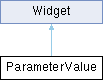
A non-visual (logical) binding to an existing Element parameter. More...
Public Member Functions | |
| ParameterValue (Element elementOrPath, string paramName) | |
| creates a logical binding to an existing Element parameter. | |
| ParameterValue (string name) | |
| creates an unbound binding, to be targeted later with bind. | |
| void | bind (Element elementOrPath, string paramName) |
| bind the widget to another parameter, or bind an unbound widget for the first time. | |
| string | toString () |
Public Attributes | |
| Value | value |
| the bound parameter's value (read and write) | |
| bool | bound |
| true if the target element/parameter was resolved (read-only) | |
 Public Attributes inherited from Widget | |
| string | name |
| widget name, given at construction (read-only) | |
| string | displayName |
| widget display name | |
| string | displayText |
| custom text to display in place of the standard value display, on widgets that show one. | |
| string | tooltip |
| widget tooltip, default is name | |
| int | x |
| x position in pixels | |
| int | y |
| y position in pixels | |
| int | width |
| widget width in pixels | |
| int | height |
| widget height in pixels | |
| int | w |
| alias of width | |
| int | h |
| alias of height | |
| table | size |
| widget size {width, height} | |
| table | position |
| widget position {x,y} | |
| table | pos |
| alias of position | |
| table | bounds |
| widget bounding rect {x,y,width,height} | |
| number | alpha |
| transparency value between 0.0 and 1.0 | |
| bool | enabled |
| boolean flag to enable / disable the widget | |
| bool | visible |
| boolean flag to toggle widget visibility | |
| bool | interceptsMouseClicks |
| boolean flag to toggle mouse handling on widget. | |
| bool | showLabel |
| show widgets label if any | |
| bool | persistent |
| flag to tell if the widget values should be serialized when saving. | |
| function | changed |
| callback function used by child widgets to be notified of changes. | |
A non-visual (logical) binding to an existing Element parameter.
Unlike the Param* widgets, this draws nothing: it exposes the parameter through a read/write value, staying in sync with host automation, modulation and preset changes. Useful to observe or drive a parameter without placing a control on the UI. It is a global function only (not a Panel method) and does not accept widget layout options.
Its changed callback is called each time the parameter changes, and once when the script's interface is built.
value is nil, writes are dropped and bound is false. An Element reference binds at once. A write whose Lua type does not match the parameter's type is dropped without an error. | ParameterValue::ParameterValue | ( | Element | elementOrPath, |
| string | paramName ) |
creates a logical binding to an existing Element parameter.
| elementOrPath | an Element reference, or a path string identifying one |
| paramName | the parameter name (as used by setParameter) |
| ParameterValue::ParameterValue | ( | string | name | ) |
creates an unbound binding, to be targeted later with bind.
Until then it shows a placeholder and its value is nil.
| name | the widget name |
| void ParameterValue::bind | ( | Element | elementOrPath, |
| string | paramName ) |
bind the widget to another parameter, or bind an unbound widget for the first time.
The control is rebuilt with the new parameter's range, unit, mapper and value; rebinding to the same element and parameter does nothing. Typically called when the element the UI edits changes, e.g. the insert effect selected in an effect rack. Raises an error when the element no longer exists or has no such parameter.
| elementOrPath | an Element reference, or a path string identifying one |
| paramName | the parameter name (as used by setParameter) |
| string ParameterValue::toString | ( | ) |